
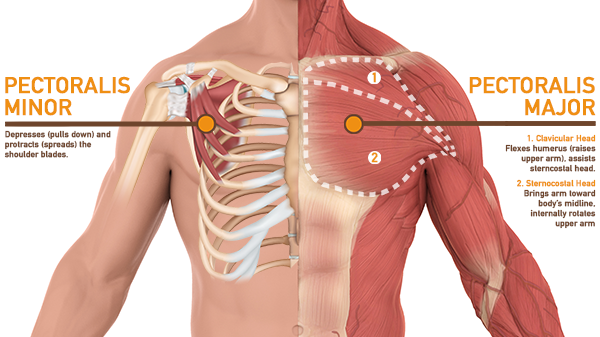
Pectoralis Major & Pectoralis Minor
The pectoral region is located on the anterior chest wall. It contains four muscles that exert a force on the upper limb: the pectoralis major, pectoralis minor, serratus anterior, and subclavius. Today, we'll focus on the two pectoralis muscles, which play a crucial role in shoulder movement and posture.
Pectoralis Major
The pectoralis major is a large, fan-shaped muscle that covers the upper chest. It has two main parts (heads): the clavicular head (originating from the collarbone) and the sternocostal head (originating from the breastbone and ribs). Both heads insert into the humerus (upper arm bone).
Functions: It is primarily responsible for adduction (bringing the arm across the body), internal rotation of the arm, and flexion of the humerus (lifting the arm forward).
Pectoralis Minor
The pectoralis minor is a smaller, triangular muscle situated deep beneath the pectoralis major. It originates from the 3rd, 4th, and 5th ribs and inserts into the coracoid process of the scapula (shoulder blade).
Functions: Its main role is to stabilise the scapula by drawing it inferiorly and anteriorly against the thoracic wall. It also assists in elevating the ribs during deep inspiration.
The Impact of Tight Pectoral Muscles
In our modern lifestyle, characterized by prolonged sitting, computer work, and driving, the pectoral muscles often become shortened and tight. This can lead to:
- Rounded Shoulders: Tight pecs pull the shoulders forward, contributing to a hunched posture.
- Upper Back and Neck Pain: As the pecs pull forward, the muscles of the upper back and neck become overstretched and fatigued, leading to pain and tension.
- Shoulder Impingement: Altered scapular mechanics due to a tight pectoralis minor can reduce the space in the shoulder joint, causing impingement and pain.
- Thoracic Outlet Syndrome: A tight pectoralis minor can compress the nerves and blood vessels traveling down the arm, causing numbness, tingling, or weakness.
Regular stretching, postural awareness, and targeted soft tissue therapies like remedial massage or myotherapy can help release tight pectoral muscles, restoring balance to the shoulder girdle and improving overall posture.